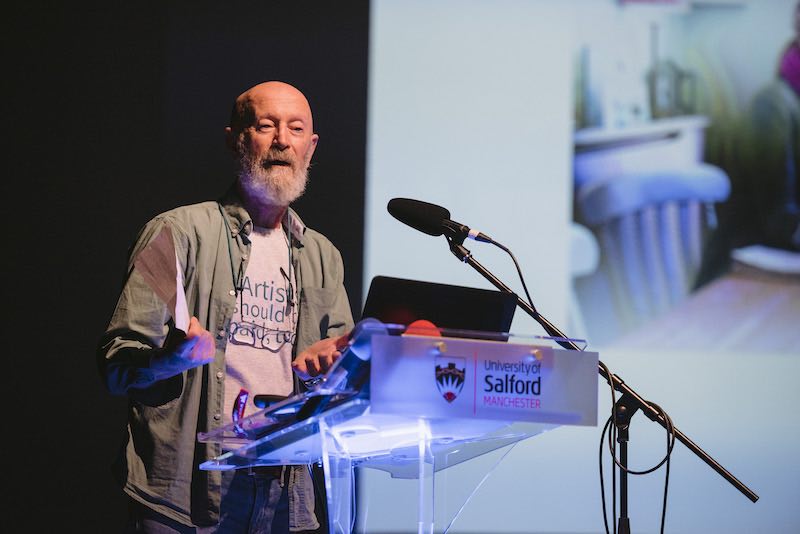
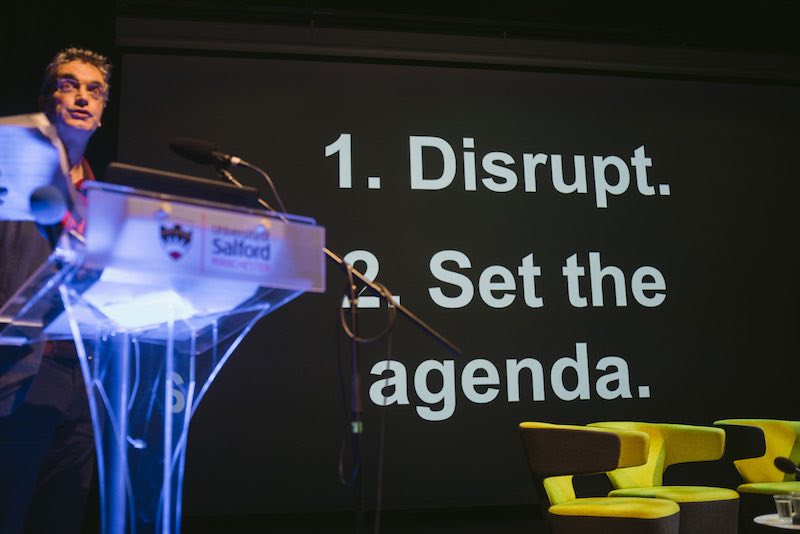
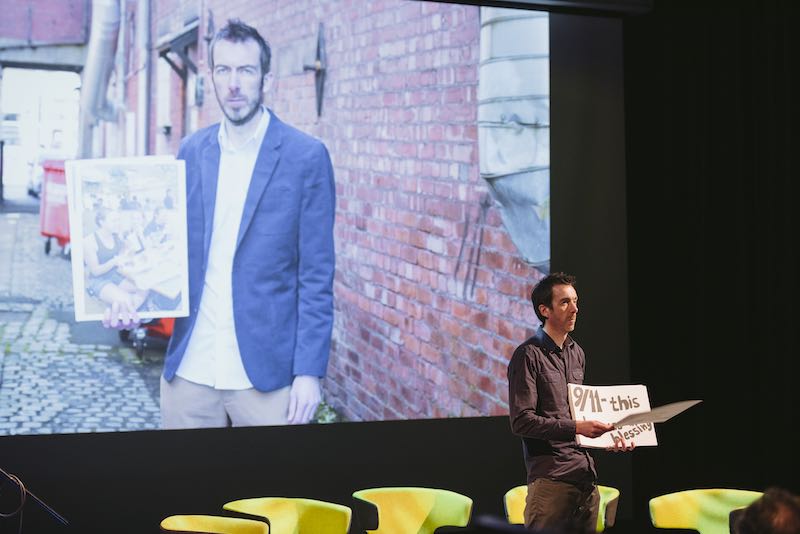
Keynote: Peter Kennard

Written by Sian Gouldstone, http://mythoughtsarecurly.wordpress.com/

I had expectations of the National Photography Symposium before I sat down to listen to Peter Kennard, clearly. They were mainly centered around the asking of original questions in photography. I was interested whether we would ask questions that haven’t been asked before, repeat or re-analyse those that have; answer questions for the first or last time; or whether we would not be able to answer questions at all. The more I learn and think about photography, the more of an enigma it becomes and this is what drives me… to teach, to learn, to discuss, and to ask and to try to find answers to the questions posed in relation to photography practices today.

Peter Kennard was interesting and driven, he offers and he asks questions of photography himself. It’s role and its procedures are scrutinized. Before all else though, I must point out that Peter Kennard is alive, still. He declared this to us himself, in person, in response to all the doubters… Ladies and Gentlemen; Mr Peter Kennard…

Kennard cites Heartfield, Rodchenko and Brecht as influencing and inspiring. I don’t know a thing about Brecht, I’ll admit; but I do know a thing or two about Heartfield and Rodchenko. Here we are, straight into montage and straight into politics with no introductions. Heartfield and Rodchenko made work that communicates and questions, it is of its time and more. It has a voice, one that speaks and asks, about the past, the present and the future. It is propaganda; it is inspiring. Peter Kennard, quite copiously, also makes work that communicates and asks questions. His work is propaganda, I guess, and it is inspirational.

Through this first session at the NPS, we were given information, factual and fictional, and asked to consider a range of issues through our relations with politics, plagiarism, Palestine, posters, poverty, printing & the photo-montage of Peter Kennard! The power of montage brings up all manner of issues, and despite the years that Kennard has been working, the issues raised by his work are still current – like Heartfield and Rodchenko, his work speaks and asks about the past, the present and the future. So far as I can see, it has always had a place, quite central, in a discussion around power and seeing in visual cultures.

Peter Kennard is of the old school of montage; paper, scissors, knives and glue. He himself explains that his work needs to be seen, and to be understood, quickly.  So it is simple.

Pk1
Peter Kennard, Broken Missile, 1980, photomontage

The work Broken Missile is a photograph that Kennard took, of a child’s toy and a spray-painted piece of cardboard. It is unfussy and is subject to interpretation, quickly.

Kennard refers to this work on his website:

‘The point of my work is to use easily recognisable iconic images, but to render them unacceptable. To break down the image of the all-powerful missile, in order to represent the power of the millions of people who are actually trying to break them. After breaking them, to show new possibilities emerging in the cracks and splintered fragments of the old reality.’

It is the simplicity of Broken Missile and its subsequent re-presentations that makes it a fascinating piece. It provokes an interesting discussion and asks obvious questions about political issues. It was the questions related to plagiarism in photography that I was more interested in though – we have seen this image plastered across t-shirts and placards; used, used and re-used. At this current time, 30 years after Kennard made Broken Missile, we are within the motions of a great change in the way in which we view, make and use images. Plagiarism and pastiche are key ways in which we are changing our understanding of the past, present and future of photography. Where do we stand?

Pk2

Pk3

 A poster of Broken Missile taped to the fence of Greenham Common by a protester, 1982

Don’t think for a moment though that plagiarism offends Peter Kennard.  His use of iconic symbols extends to incorporate iconic paintings. Haywain with Cruise Missiles was a response to the siting of US missiles in Britain. In this, Kennard uses Constable’s Haywain to reinvigorate discussion on political issues, to symbolise the much-loved British landscape and possibly to metaphorically refer to the invasion of something that doesn’t necessarily belong to you.

Pk4
Peter Kennard, Haywain with Cruise Missiles, 1980, photomontage

Right now, I am introducing ideas from Kennard’s talk, but large debate on plagiarism, pastiche, mimic and copyright can ensue… and it would be right up my street! It raises the very contemporary discussion around authorship and ownership, audience and meaning.  How are they changing in a very digital and accessibility savvy period? Kennard himself was quite clear that he doesn’t have the legal team to govern the dissemination of his images beyond the uses that he creates them for. He goes on to say, however, that people will make money from his work, but if in the process of this happening, the money goes to the correct cause intended by his work, then he has no problem.

The rights to use images, who can see and use images, and how images are shown are all relative to Kennard’s approach in one way or another. He tells us that his shows, and other work, can be censored and filtered politically. Restrictions are literally, or metaphorically placed around work shown in public. This leads to one of the aspects of Kennard’s approach to his work that speaks to me of questioning. He refuses to be bound by the exhibitory nature of his work. Kennard shows in as many different and engaging ways as possible. On every seat in the auditorium was a newspaper page, and advert for his new show. Kennard showed manual work, darkroom work, gallery work, public intervention, digital work & interactive work.

The Self Portrait of Tony Blair was shown in a shop window, ‘Santa’s Ghetto’, on Oxford St; a piece that allowed interaction from the public, that touched on a contemporary zeitgeist related to self-imagining and identity.

Pk5
Peter Kennard, from Santa’s Ghetto, 2006

Pk6
…in the ghetto’s window on oxford street, London (http://www.kennardphillipps.com/)

Kennard also spoke of the café that he helped create in the City of London in Leadenhall market. The café offered soup for bankers, calculated at the same proportion of their average salary as an average African worker would pay – soup was charged at £111 per cup.

The issue of subversive work in public spaces raised questions about the traditional values of the art world. How accessible is art everyday? Do traditional artistic values and accessibility to controversial imagery limit photography as a genre?  Kennard used an example where Orange censored a Christmas message that he’d made. Orange subsequently withdrew the work, as they needed to bear in mind their corporate identity. The irony of this is that Orange lecture on censorship, and yet appear to censor work themselves.

The last thing that Kennard talked about was his book @Earth. @Earth is a sequence of pictures, which is intended to be read as a whole sequence. It is presented as a series of folders – each opening to reveal its series of images. Kennard says that a montage is a sentence. With this in mind, @Earth and can be read with a strong, intentional narrative. In some sense it is a retrospective thus far of Kennard’s career.

Kennard is keen to stress that the work he produces is primarily in montage.  Where collage stresses no similarity or reference between the images it uses, a montage does. The montage recognises skill on a surface, its images work together to communicate, to relate issues and to ask questions about the nature of what it presents. This is a metaphor it seems, for the careers work so far of Peter Kennard.

Peter Kennard can be found at http://www.peterkennard.com/ and at http://www.kennardphillipps.com/.

THE PRINT MARKET

THE PRINT MARKET


Every photographer wants to sell their work. Every gallerist wants to sell photographer’s work. But it is so much easier said than done. And yet, at the high end of the photography market, the Gursky’s and Sherman’s of this world sell for millions of dollars.

This talk was an informal discussion about the print sales market, between Chair Jeffrey Boloten, Managing Director of Artinsight, Zelda Cheatle, London based gallerist, and WM Hunt, US based collector, curator and photographic consultant. A match made in heaven; the speakers knew one another well and there was healthy, light hearted banter, but it proved invaluable to have a trans Atlantic perspective; one which, as the talk went on, was evidently a key issue in this topic of the print market.

Jeffrey Boloten started with a little run through of the art market at present, and photography’s place within it. It seems that, after a little lull at the end of last year, sales are on the up again and the photography market is more buoyant than that of the general art market. The photography market has evolved over the years to include prints not originally made to sell; fashion photography, reportage, photographs documenting performance artists and installations are now all equally sought after as art in their own right. This is an interesting development, given that prior to this the market was predominantly made up of fine art photography, made to sell. But here’s the thing, and was pointed out by Cheatle; dedicated photography galleries don’t sell photography. Photography only sells in art galleries.

And this is the crux of the matter for me. Working in a dedicated photography gallery, I have experienced this first hand; Photofusion struggles to sell prints. Someone in the audience made the point that dedicated photography galleries often show more reportage based work, and of course there is place for that kind of gallery and for photographers to get that kind of exposure (later on, Hunt did admit it was hard to sell reportage stuff; people don’t want to live with that kind of thing on their walls). But as Cheatle pointed out; look at the new Saatchi show, Out of Focus. All of the photographers in that exhibition are represented by art galleries; they (along with Cindy Sherman and Andreas Gursky who sell at the top end) consider themselves artists who use photography. They are not photographers.

In saying this, Cheatle confirmed something that I had been thinking about for a while. I remember bumping into James Hyman at the London Art Fair, where he was exhibiting paintings, and I asked him why he wasn’t exhibiting photography. He said he takes photography to Paris Photo, and takes it to fairs in New York, but it just doesn’t sell in London. His theory was based in the history of photography; in France photography had been picked up by the Surrealists as an art form in the 1920’s, and from then on was accepted as art. In the US, the beautifully crafted prints of Edward Steichen and Ansel Adams were quickly accepted as art; in contrast, the UK had documentary magazines such as Picture Post and the point of photography was very much as a documentary tool. This theory makes a lot of sense to me, and I put it to the panel. The response I got was that the people who buy prints in Paris Photo are German and Italian (not French!); and yet they did agree that the buzz surrounding the event in Paris is huge, and amongst everyone, collectors and non-collectors alike. That didn’t happen in the short run of Photo London, and I remain convinced that the reason for this is that photography is more ingrained in their psyche as an art form. It is still true that New York leads the world in the marketing of photography as art, although new art markets are springing up in Russia, India, China and the Middle East.

Talk then moved onto the subject of the quality of prints, and the fact that longevity of digital prints is suspect. Hunt is convinced they won’t last, and I thought it interesting that the Director of Harman Technologies, who was sat in the front row, didn’t make a sound to contradict him. So what happens when a digital print, bought at a high end auction, does fade? Hunt recounted the story of the fading Gursky hung in Tate Modern; apparently it is the dealer’s responsibility to re-print if such a thing happens. This then raises a lot of questions; Is it the same print? Does it have the same value? The feeling did seem to be that analogue prints were better quality (apart from when they’re not fixed properly, as in the case of Hunt’s Arbus which he sold to an unsuspecting dealer in Dubai!). And then of course the big editioning question. It was refreshing to hear Zelda Cheatle’s take on it; she sees editioning as a marketing tool, which actually doesn’t mean a thing. A print made now is going to be different to a print of the same image made in ten years time, or even tomorrow. Which makes editioning irrelevant; it’s only there because dealers like the idea of rarity.

The talk was incredibly insightful, with experienced speakers who were great storytellers and made this potentially dry subject a lot of fun. However, all of this chat was very much geared towards the high end photography market, and although Jen Bekman’s 20x200 online gallery initiative was given a brief nod, there was not a great deal of talk about the lower end of the market. Which I think is a shame, because let’s face it, most of the people in the audience won’t be selling their work at millions of dollars. After all, they consider themselves photographers, not artists.


Written by Carole Evans
www.caroleevans.co.uk

Some references on the discussion of women in photojournalism

(1) Although this is a rather dated piece, I found it interesting how some iconic women photographers have said their gender has nothing to do with it: "Women in Photojournalism and Combat" by Robert Stevens, January 2003

Normal 0 false false false EN-US JA X-NONE

(2) A piece by Paul Melcher stirred some debate and a response by Washington DC based photographer Melissa Golden: "On gender and photojournalism: a response to Paul Melcher by Melissa Golden " May 13, 2011

(3) Here is Paul Melcher's original piece: "Why Is a Photojournalist’s Gender Relevant to Their Work?"  May 9, 2011

Normal 0 false false false EN-US JA X-NONE


Normal 0 false false false EN-US JA X-NONE

Short films about photography archives

Some short films on the subject of photographic archives, as background to the Symposium session with Pete James, Jem Southam and Brigitte Lardinois.

First, a series of films made by Source Photographic Review as part of their three month season dedicated to photography archives. The second of these on John Blakemore features an interview with Pete James. There's also link to the competition Source is running to find your favourite archive photo.

Second, a film Storage, from Process Arts, about the archive of Professor Val Williams, who is the director of PARC, the Photography and the Archive Research Centre.

National Photography Symposium 2012 Programme

Hashtag: #NPS4


Submit your questions to Photography Question TIme via Twitter with the hashtag #NPSQT.


All sessions happen at Somerset House unless stated.

Updated 19.4.12. This is the final programme but please bear in mind there might be small changes.


Tickets avaiable from Redeye or the World Photography Organisation


Friday 27 April 2012


13:00 onwards: registration in Portico Room / Photographer's Lounge, Somerset House.


14:00: Archives. How can we decide which photographic work gets preserved in archives, and what should photographers do with their own work if they want it to be preserved? This session outlines the latest thinking on photographers and their archives; developing best practice guidance specific to photography, deciding on the most appropriate content of archives, and the role of institutions. Speakers: 

Jem Southam, photographer and professor in the School of Art and Media at Plymouth University

Pete James, Head of Photographs, Birmingham Central Library

Brigitte Lardinois, Deputy Director of the Photography and Archive Research Centre at University of the Arts London

Introduced by Paul Herrmann, Director of Redeye


14:00: Copyright discussion. This session, led by photographer David Hoffman, aims to be a frank exchange of thoughts on copyright, looking at the growth in infringements, new ways of discovering these, and how photographers can recover what is owed to them. David will outline his recent court case establishing that the belief of innocence is no defence to a copyright infringement claim. What will be the role of the forthcoming UK small claims court for intellectual property, and why does the Intellectual Property Office think that the court will only handle 150 cases per year? Please come with your experiences and ideas on this subject.


16:00: Break


17:00: The ethics of press and public photography, with particular reference to the implications of the Leveson Inquiry. At what stage does photography become harassment? Should there be controls? More broadly, where is the press heading in its use of photography? Should the press, citizen journalists, and members of the public all be treated the same or differently, whether in general or at newsworthy events? This panel discussion features a range of points of view - that of a photographer who gave evidence at the Leveson Enquiry, a leading picture editor and a champion of citizen photography.

Speakers:

Neil Turner, photographer and vice-chair of the British Press Photographers' Association

Pauline Hadaway, Director of Belfast Exposed Photography

Alan Sparrow, Chairman of the Picture Editors Guild and Executive Picture Editor of Metro UK

Chaired by Andrew Wiard, photographer


17:00: The print market. A relaxed, informal and open ended discussion of the photographic print market with three leading figures, starting with a quick run-down of the state of the market. Which areas of the market are doing the best, what work is popular with collectors, and why? Speakers:

Zelda Cheatle, Gallery Director of Margaret Street Gallery

WM Hunt, collector, curator and photographic consultant

Chair: Jeffrey Boloten, Managing Director, ArtInsight


Saturday 28 April 2012


09:00 onwards: Registration in Portico Room / Photographer's Lounge, Somerset House.


10:00 to 10:45 (Strand Palace Hotel): Keynote – Peter Kennard, the UK's most influential photomontage artist, talks on his life and career.


11:00 to 12:45 (Strand Palace Hotel): Work and the economy. If the Western economy is settling into a slow decline what are the implications for expenditure on photography? How should organisations and photographers plan for the future? How are photographers reinventing themselves for new audiences and the new economy? What are our responsibilities as organisations and individuals to talented, but increasingly unemployed, young people? Speakers: 

Esther Teichmann, photographic artist

John Wright, portrait and fashion photographer, and board member of the Young Photographers' Alliance

Sara T'Rula, documentary photographer

Chaired by Paul Herrmann of Redeye


11:15 to 12:15 (Somerset House): In conversation: critical to commercial. What compromises are made when photographers articulate their critical approaches and aesthetic styles into commercial vernaculars? While it's not unusual for clients to take the best artistic imagery and then shape it for their own ends, it's more interesting and arguably less of a compromise when photographers take the initiative, often by working more closely with appropriate clients. In this open-ended session the photographic artists David Moore and Ewen Spencer explore these issues in relation to their own and others' work. Introduced by Dewi Lewis, publisher.


12:45: Break


14:00: (Strand Palace Hotel): Collaborations, whether between organisations or individuals, can generate new thinking, save on resources and increase profile. But they often don't seem to go as smoothly as they might, and both people and organisations are protective of their own ideas and projects. At the organisational level in photography, is there more we could do together on collaborative ventures? Between individuals, how can we encourage more collective and collaborative work - perhaps across disciplines or professions - or can it be counter-productive for photographers to work this way? Each member of this panel has a special interest in collaboration in their work.

Speakers: 

Anna Fox, photographer and Professor of Photography, University for the Creative Arts, Farnham; 

Anthony Luvera, artist, writer and educator;

Chaired by Anne McNeill, Director, Impressions Gallery, Bradford.


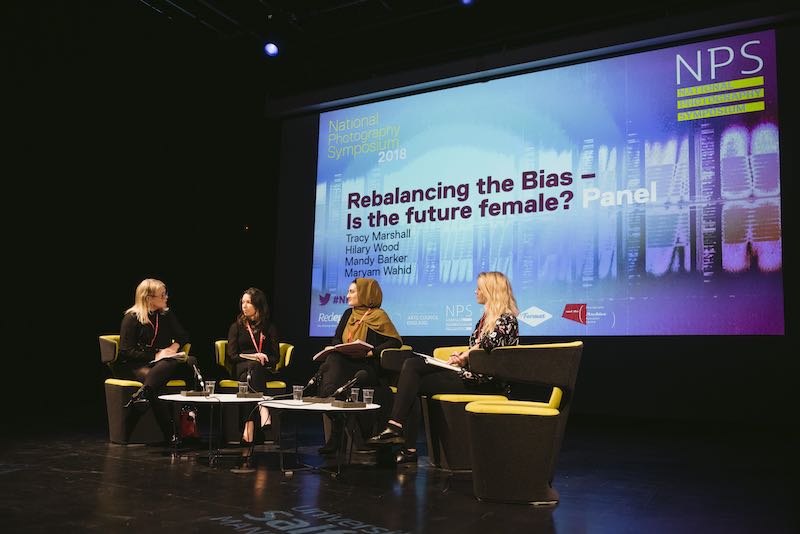
14:00 (Somerset House): Women in Photojournalism. While women outnumber men on photography courses, the opposite is still true in many areas of photography; none more so than photojournalism, news and editorial photography. What are the reasons for this? Is there a "boys' club" mentality among some photographers, pressure or pigeonholing from the picture desks and commissioners, or are there reasons why women are less interested in certain areas of work? What advantages do women photojournalists have over their male counterparts? And how does the UK compare with other areas? Accomplished photojournalists will talk briefly about their own work, and discuss this area: the freelance photojournalist Laura El-Tantawy, Reuters staff photographer Suzanne Plunkett; Chaired by Carmen Valino, photographer.


15:45 Break


16:15 (Strand Palace) Photography Question Time: the format is familiar from the BBC, but the subject matter is all photography; this is a chance to put your questions to a panel of the most interesting and influential people in photography. In your pack you'll find a question slip. Please fill it in with any questions you would like to put to the panel and hand it back to the registration desk by 15:45 on Saturday.

On the panel:

Simon Norfolk, photographer

Dewi Lewis, publisher

Anne McNeill, Impressions Gallery

Andrew Wiard, photographer

Chaired by Paul Herrmann of Redeye

Submit your questions to Photography Question TIme via Twitter with the hashtag #NPSQT.


17:30 Break


18:15 (Strand Palace): WPO session - tickets must be booked separately. In the Photographer's Studio with William Klein and Vanessa Winship.


Sunday 29th April 2012


10:30 Informal gallery visits. Details to follow.


Speakers include:

Alan Sparrow

Andrew Wiard

Anna Fox

Anne McNeill

Anthony Luvera

Brigitte Lardinois

Carmen Valino

David Hoffman

David Moore

Dewi Lewis

Esther Teichmann

Ewen Spencer

Jeffrey Boloten

Jem Southam

John Wright

Laura El-Tantawy

Neil Turner

Pauline Hadaway

Pete James

Peter Kennard

Sara T'Rula

Simon Norfolk

Suzanne Plunkett

W.M. Hunt

Zelda Cheatle


NPS4 - 27 to 29 April 2012, London

We're please to announce that the fourth National Photography Symposium takes place at and around Somerset House in London, in partnership with World Photo London.

In 2012 the Symposium covers issues around ethics, the press and the environment; the pros and cons of collaboration and co-operation for both individuals and organisations; recent developments in archiving; new patterns and models for employment in photography; and the effects on photography of global economic change. Around 20 speakers, including many top professionals from across photography, will present on these and other subjects.

The main days will be the afternoon of 27 April, and all day 28 April. An informal session will take place on the morning of 29 April.

Full details and tickets very soon!

Reflecting on NPS3

Almost two weeks have gone by since NPS3 and praise for the weekend event is rolling in. For those of you who missed out or would like to refresh your memory of the speakers and sessions, we've collected a few of the reviews here.

Blogs

Karen Strunks, who gave her own talk on the 4AM Project, reviews the weekend here.

Sara T'Rula gives a day by day rundown of NPS3.

Sian Gouldstone talks about the keynote sessions.

Brenda Burrell visually documents John Davis' photowalk.

Twitter

We encouraged attendees to tweet whilst at the symposium using the hashtag #nps3. Check out NPS3 - A Weekend In Tweets!

Screen_shot_2011-05-24_at_14

Audioboo

All recordings are provided by Documentally:

I'm A Photographer, Not A Terrorist - The Book

Day Three of the National Photography Symposium

Insanity Helps - Photgraphy By Christopher Finch


David Drake, Ffotogallery's Director, talks about how he's imagining a new photography centre in Wales

I haven’t yet got a realized project to talk about, so as well as talking about our plans in Wales I’m going to reflect on how recent developments in visual culture, specifically in contemporary photography, impact on how we conceive of the role and nature of photography centres in the future. I’m going to build my arguments with reference to Ffotogallery’s work and the ongoing efforts to establish a national photography centre in Wales. I will also share some personal views on the conceptual and architectural models that have dominated capital developments in the UK visual arts sector over the last 15 years.

 The story so far in Wales:

 2001 – Vision set out for a new National Centre for Photography in Wales. Ffotogallery, having operated a gallery successfully in Cardiff since 1978, relinquishes its existing lease arrangement and moves to an interim arrangement on split sites: Administration, education and darkrooms at Chapter Arts Centre and a gallery at Turner House, Penarth, a historic building owned by the National Museum of Wales.

 2003 – Arts Council of Wales pledges £2.4m Lottery funding to establish the new centre at Margam Park, near Port Talbot., a place with family connections to Fox Talbot. Fundraising and development planning begins in earnest. Plans include five contemporary exhibition spaces, an interactive gallery, workshop and teaching spaces, library and digital archive facilities

 2005 – Partnership in place between Ffotogallery and Neath Port Talbot Borough Council, who own and manage the Margam Park site as a visitor attraction. Idea to integrate a ‘visitor experience’ of contemporary photography with exploration of the heritage, environment and landscape of Wales.

 2007 -  Project collapses and site lost due to local authority pulling out, despite capital funding being in place. Arts Council holds open its Lottery funding subject to alternative site being identified.

 2008 – no suitable alternative site identified. Ffotogallery Director, Chris Coppock, decides to leave after 19 years and David Drake appointed as successor, starting in March 2009.

 2010 – after year of operating programme and reviewing organisation’s work, new business plan submitted to Arts Council, includes the development of an integrated centre in central Cardiff location. Outline brief for new photography centre developed and discussions opened with City Council over site options. Arts Council of Wales reaffirm commitment to the capital plan, include Ffotogallery in the National Portfolio after Investment Review, and indicate availability of Capital Lottery Funding from 2012.

Let's briefly consider some arguments for and against dedicated photography centres in the UK:

For:

Photography remains a popular and accessible medium, with high audience interest and engagement in both contemporary and historical work

We can present the exciting UK and international photographic work that doesn’t get adequate exposure or informed critical examination by writers and curators elsewhere.

We can explore in depth specific narratives around contemporary photography and its development. These are under-represented and in some cases woefully unaddressed by the current generation of contemporary art curators and programmers in UK museums and galleries.

There is a loyal and growing artistic constituency that needs a focus for their area of interest: photographic artists continue to make work. The fine art or documentary photography degree courses in the UK remain oversubscribed, despite the challenge of high tuition fees and limited career opportunities.

Photography centres are not just about exhibition of work, they offer opportunities for creative participation, life-long learning, online and print publishing, bookshops, cafes, artist groups, membership for artists etc.

Against:

Digital developments have expanded the field of photography such that it is now inseparable from the wider contemporary visual culture.

Given the massive number of people who enjoy photography online and in print form, why spend a lot of money on gallery exhibitions which only a few people visit?

I believe these two questions can be addressed together by flipping the arguments around.

I would argue that new and existing photography centres should intelligently examine contemporary photographic art in this complex and changing cultural landscape, avoiding doctrinal adherence to an existing ‘canon’ of artists or fetishisation of the photographic image in its traditional form or context. Secondly, I think we need to unpack what we mean by a huge online audience for photography, and focus on those with a specific interest in contemporary photography as art. Although I can’t prove it, my anecdotal evidence is that people with a serious, critically engaged interest in contemporary photography enjoy it online, in print form and in galleries – and visiting galleries in photography centres can provide both a social experience and reflective environment for viewing work quite unlike the other platforms.

In terms of how photography centres embrace the digital opportunity, a few words of caution apply here:

Firstly, a move towards being digital media centres brought about the closure of several dedicated photography galleries in the 1990s – Watershed  and f Stop being two such examples.

Secondly, we should be careful not to confuse or worse still lose our most loyal audiences. Ffotogallery ran a new programme called Vision On in 2009, which looked at data visualization, gaming, sound and vision, social networking etc. Created a participatory ‘anti-gallery’ feel to the space.  We gained some new people, but lost a major share of our regular audience for the duration of the season.

Real or perceived hierarchies in the art world

When I got the job as Director of Ffotogallery, a well known international curator I know questioned why I wanted to work for a medium specific visual arts organisation. His actual words were “No self-respecting photographic artist would turn down an opportunity to exhibit at the Serpentine or Whitechapel in favour of a show at The Photographers Gallery”

My repost was to say that most artists would jump at either or both opportunities, depending on the context in which they wanted their work presented. But I think we have to acknowledge that there is a damaging prejudice against photography in some quarters of the contemporary art world - Paul Graham addressed this issue in a speech at MOMA, New York last year:

Paul Graham ‘The Unreasonable Apple 2010

Whilst acknowledging how the major contemporary art institutions have recognized Robert Frank, Martin Parr, Stephen Shore alongside Jeff Wall, Thomas Demand and Cindy Sherman, Graham states:

“what of those who work today with equal commitment and sincerity, using straight photography in the cacophonous present? I will not name names here, but for these serious photographers the fog of time still obfuscates their efforts, and the blindness j’accuse some of the art world of suffering from, narrows their options. It means their work will almost never be considered for Documenta, or placed alongside other artists in a Biennale, or found for sale in major contemporary art galleries and art fairs’.

Clearly there certain big name artists whose agents and representatives will block approaches and want to position them only in relation to the most powerful and well-resourced visual arts institutions in the UK. However, thankfully I have found no shortage of high calibre, prominent international artists to work with and who see it as a privilege to be invited to exhibit in Wales.

Let's turn to some ideas about visual art buildings and architecture that have been dominant in the UK over the last 15 years

The most significant Lottery awards have tended to go to 'Grand Projets', often with lavish claims about their impact in terms of local regeneration and sold as new visitor attractions, sometimes including an 'interactive' technology mediated visitor experience

-       costly conversions of industrial and other buildings (eg. The Baltic, Tate Modern)

-       iconic architectural statements (eg. Rivington Place, London, The Public, West Bromwich)

-       modern extensions to existing museums and galleries (the V & A, Holbourne Museum)

My critique of many of these developments:

Architect’s vision often compromises artistic purpose

Costly to build, costly to sustain

Not very green

Product of Lottery glut

Utilise expensive technologies that almost immediately become redundant or superceded by new platforms

Many have focused on ‘museum paradigm’ – collections and curation in an art historical context

Tendency towards brand name/institutional dominance rather than real quality and innovation

Conservative view of audience needs and growth potential, somewhat risk averse

My ambition for Ffotogallery, and for the new photography centre I hope to establish in Wales

Fleet of foot organisation that is well networked in terms of the evolving cultural agenda

Engaging with new and established artists, at many levels, and emerging artistic practices

Staff who are energetic, enthusiastic and intellectually engaged in their subject

A programming approach that offers effective ‘mediation’ between artists and audiences

An architectural design that makes best use of resources – high quality, versatile spaces for exhibition, production and training, education and social interaction

Ability to programme ‘cross-platform’ – online and physical

Technology that is as ‘future proofed’ as possible.

The right ambience – a rich sensory experience (the smell of coffee and freshly baked muffins, a well stocked bookshop and a bar that is welcoming and a good meeting place for artists and creatives).

Central location with high visibility and good accessibility

A building of a scale and ambition for the development that is sustainable in economic and environmental terms

A business model that strikes the right balance between subsidy and self-generated income

Thank you!


david.drake@ffotogallery.org

www.ffotogallery.org

Twitter: @ffotodavid

Karen Strunks talks about her global photography project, the 4am Project

First of all, a big thank you to all the people behind the National Photography Symposium event! What a wonderful, photography inspiring weekend!

I was honoured when Paul Herrmann asked me to speak about my global photography project. To let you into a secret, speaking at this event was one of my goals, so it was fantastic to be able to realise it.

In case you missed my talk, I captured it on video. I gave an overview of the 4am Project, how it began, how I harness the power of social media and free online tools to run it and gather a following, who the project appeals to, some facts and figures and some of my plans for it's future.

4am Project presentation by Karen Strunks at the National Photography Symposium from Karen Strunks on Vimeo.

If you have any questions or want to get in touch, you can find all my details here.

Thank you again to the National Photography Symposium, and Red Eye and Look11. I'm looking forward to the next event!

How British Photography Found Its Voice

Photographer Paul Hill, who talks at the 2011 NPS on photographers and their archives, here explores the growth of British photography in the 1970s.


The 1970s was, in my opinion, photography’s most important decade of the 20th century. During this period its traditional practices were questioned – even undermined – its profile as a medium of creative self-expression was raised immeasurably, and the teaching of the subject changed beyond recognition.

This is my view – partial and self opinionated – but at least I was there, hopefully providing the researchers of today, who have no particular axe to grind, with primary material to help them analyse this exciting era with critical detachment and insight.

I want to stress the importance of education and dissemination during this period. The products were good and the message worth listening to, so let the wider public, as well as the cognoscenti, know about it. No one will be beat a path to your door until they know your address. Promoting debate, as well as confronting cliché-ridden photography and out-moded custom and practice, was crucial, and via various avenues, including academics, who had up to then viewed the subject as a purely vocational one, photography found a new position on the cultural and artistic map of Britain.

Of course, there is a personal pre-history, and mine is similar to that of many who joined the cause – unusual. I became enamoured of personal photography, as we called it then, through journalism. I was a newspaper reporter before I decided to make one of my hobbies – photography – my career when I became a freelance in 1965. Although news photography was my mainstay, I began to appreciate other sorts of image making, and was particularly influenced by Bill Brandt’s Shadow of Light in 1966. It opened my eyes to exciting new ways to make photographs, and probably changed me more than I realised at the time. When I was working for the Financial Times a year later, I was given a copy of Creative Camera Owner (later Creative Camera ) by the picture editor and started to understand what self expression in photography meant. An FT  reporter friend became features editor of the Telegraph Magazine and invited me to meet their new picture editor, the inestimable and controversial Bill Jay , who had just been sacked as editor of Creative Camera. He gave me a few assignments and lots of anecdotes about my heroes, like W.Eugene Smith and Brandt, and the new kids on the block: Tony Ray-Jones, Diane Arbus, Lee Friedlander, and Garry Winogrand, amongst others.

I also accompanied Bill when he visited the Sir Benjamin Stone archive in the Local Studies section of Birmingham Central Library (I lived in nearby Wolverhampton at the time), and sought him out one or two estimates from printers for his new magazine, the highly regarded Album. I have many stories about Bill, and visits to the magazine’s tiny offices and his friend and advisor, David Hurn’s London flat,that would graphically illustrate the eclectic mix of photographers that emerged from the 1960s. I would characterize most of them as buccaneers and mavericks who wished for photography to be regarded as an art form, although they themselves were largely self taught and had only a sketchy knowledge of the history of photography, let alone art history. The optimism and pizzazz of the sixties had given them self-belief and confidence to challenge the establishment and change the status quo.

But there were other emergent photographers, equally determined to alter things - but politically - who also employed photography – the socialists and militant marxists. They championed socially concerned photography, and thought ‘art photographers’ (a new designation then) were navel-gazing, self indulgent w**kers. It was thought by many that ‘real photographers’ were macho hunters who shot pictures and captured actual life.  Although the agendas were different, the two camps rubbed along together quite well, with occasional ideological skirmishes, as outlets for personally driven work were few and far between, with no specialist galleries and only one or two British photographic magazines (except Creative Camera) prepared to infrequently publish experimental work.

Frustrated by the increasingly trivial photographic content of newspapers in the early 1970s, I decided to try my hand at teaching. After a spell at North Staffordshire Poly in Stoke-on-Trent, I was invited to become a part-time lecturer at Trent Poly in Nottingham. Bill Jay taught there part-time, and he recommended me to the head of photography, Bill Gaskins, who was also to become chairman of the recently established Photography Committee of the Arts Council. Gaskins wanted to start a new kind of photography course that encouraged experimentation and placed the medium in a wider cultural and historical context.

One of our students, Diane Lyons (later of Aperture) went to work for The Photographic Journal and invited me to write a piece for that august RPS monthly magazine. Reflecting my disenchantment with my former career and wanting to wave the flag for photography as art, it was entitled: Photojournalism – The British Obsession[1]. Despite its controversial tone and content, the membership failed to put pen to paper, unlike the response I received to an article I wrote for Camera three years later. British photography seemed to me to be largely in a state of torpor then. But my depression was partially lifted that same year (1973) when I was invited to exhibit in the first major show of contemporary British photography at the Arts Council’s Serpentine Gallery in London. Called Serpentine ’73 and curated by Peter Turner (of Creative Camera) and Sue Grayson, it drew large audiences and many newspaper and magazine reviews, which, predictably, dragged up the then frequently debated question: ‘Is photography art?’ Thankfully, the public loved it and it proved an inspiration to many photographers and students who were delighted to see their medium in the art spotlight at long last.

 Although social documentation and studio practice were in the new Trent Poly course curriculum, making photographs that were artworks in themselves was encouraged more enthusiastically. Creative imagination and chance taking were valuable attributes whether the student wanted to work as a commercial photographer or fine artist. The craft of printmaking was also taught as the collector of fine prints will always want hand made, archivally processed work. This was a new market for photographers and when we submitted our proposal for a diploma course in Creative Photography, in conjunction with Derby College of Higher Education (Gaskins was head of photography there before moving to Trent), we built this component into it. The course was unique, and because of this, it attracted talented students from around the world as well as the UK, and the top names in photography as visiting lecturers.

In 1974 I was made a full-time lecturer and moved to Derbyshire, where I would later set up The Photographers’ Place with my late wife, Angela. That same year Gaskins asked me to organise a summer school, which, I thought, should be primarily aimed at photography lecturers, many of whom were eager to see at first hand what personal photography and art photography were all about. Run in conjunction with the Society for Photographic Education (now defunct), it ran for two weeks in Nottingham and was called a workshop. I invited David Hurn, who had recently started a course in documentary photography in Newport, Gwent, and Peter Schlessinger of Apeiron Workshops in the USA, to lead the teaching, aided by an American member of the Trent staff, Thomas Joshua Cooper. There were contributions from Chris Killip, Gilles Peress, and Raymond Moore, who later joined our photography department at the polytechnic, amongst others.

The Trent/Derby students were soon getting noticed through exhibiting in places like the RPS in London, and via their final diploma shows in Nottingham and Derby. Because their photographs ‘showed a maturity which made it difficult to believe that it was the work of students’[2], the course attracted attention and envy. By now Tom Cooper and I were firm friends, as well as teaching colleagues, so we decided we needed a credo. In the same year as the summer school, we wrote the polemic: Can British Photography Emerge from the Dark Ages? and sent it to The Guardian, together with a selection of our students’ pictures. The arts editor rejected it and sent the article back minus the pictures! Eventually they paid for the lost work, so the students at least got something. Peter Turner heard about this episode and asked if he could put the piece, with new pictures, in Creative Camera[3]. The article and illustrations attracted attention (and more student applications) and writers and reviewers came to Nottingham to see this ‘new’ photography. This was decades before Damien Hirst and his fellow art students at Goldsmiths College in London created a media buzz around their Frieze exhibition. Unfortunately, the students did not get their work back from Creative Camera either. The editor had spilled coffee over it! But sacrifices have to be made if you want people, particularly the media, to take notice. The students were not entirely convinced, but we told them that those  who choose a career in the media – and many did - would at least make sure they valued the work of contributors better than theirs had been.

Outside formal education other exciting initiatives were emerging, like the Real Britain postcard project, Co-optic, and the community orientated Half Moon (later to become Camerawork) and Cockpit workshops in London, and Midland Group Photography in Nottingham. It started the annual Midland Group Open Exhibition in 1972, which attracted photographers from all over the world, including Robert Mapplethorpe, amongst others. Each show was selected by eminent curators, critics, artists and photographers, like John Szarkowski and Ron Kitaj. Earlier in the 1970s, the most important events was probably the opening of The Photographers Gallery in London (1971), to be followed by Impressions in York. One of my proudest moments was having a show at the old PG in 1972. This was somewhat diluted when they left my name off the poster announcing that month’s exhibitions. This omission only served to spur me into sending my own press release to the media, and to make sure that in future I would closely monitor marketing and publicity as well as hanging the work!

Like many others at the beginning of that decade I was pretty ignorant of a great deal of the history of the medium. But through my friendship with recent American graduates who taught at Trent Poly, like Tom and his predecessor, John Mulvaney, I found out an immense amount as they were taught by the best around at the time – Van Deren Coke and Beaumont Newhall – at the University of New Mexico, where Bill Jay became a student after Album and the photography study centre he started at the Institute of Contemporary Art, London folded in 1972. He was followed by Valerie Lloyd, who later became the RPS Curator when the society moved to Bath. I was on the Arts Council Photography Committee in the mid 1970s when the RPS applied for financial help. We all thought that the best thing about the society was its fabulous collection. Van Deren Coke was commissioned to examine it and report to the council. He was scathing, and concluded that the collection should be properly catalogued and conserved as soon as possible as it was in peril. We recommended funds be given to the RPS for 3 years for this to be done, and Val was employed as a cataloguer. But she soon referred to herself as ‘curator’, and job creation funds were found to take on workers – often former photography students – to start the cataloguing, which, I believe, went on for the next 20 years!

My photographic education was further enhanced when Tom and I decided to interview some of the ‘movers and shakers’ of 20th century photography, from Ansel Adams to Man Ray, Cartier Bresson to Cecil Beaton, between 1974 and 1978. Originally published in the tri-lingual monthly magazine Camera, the 22 interviews were compiled into a book, Dialogue with Photography[4], which has never been out of print. It was extensively reviewed around the world, and New York Times art critic Hilton Kramer thought parts were ‘essential reading’ for those interested in photographic history.5 We mostly funded what turned out to be a complex and lengthy project, through the reproduction fees for each interview we received from Camera. In 1976 the editor, Allan Porter, asked me to write an article on photographic education in Britain6 to accompany portfolios of my photographs and those of Raymond Moore and John Blakemore. All three of us taught on the Trent/Derby course at the time. My piece was deliberately hard-hitting and critical of the educational establishment. Although very similar to the ‘Dark Ages’ and ‘ British Obsession’ polemics7 in tone, this time, two and three years on, there was a reaction, with numerous letters to the editor of the British Journal of Photography and a very trenchant and vitriolic response from the well-known photographer and educator, Walter Nurnberg8.

A benefit of having connections with the Art Council and the Photographers Gallery was being able to know what exhibitions were being planned and what photographers were visiting the UK. In 1976 I learned that New York-based photographer, Ralph Gibson had been commissioned to do some work in England. This gave me the opportunity to ask Ralph, a seasoned workshop leader, if he would do one for me in Derbyshire whilst he was over here. Angela and I had been considering the idea since the Trent summer school 2 years earlier as our rural location was most suitable – if a little cosy – and had been successfully used by my poly students for field trips. He agreed, and The Photographers’ Place, this country’s first residential photography workshop, was born. Teachers, students and helpers who participated over the next 20 years are too numerous to mention, but they included youngsters, like Andy Earl, Tom Sandberg, Debbie Baker, Paul Graham, Greg Lucas, as well as big names, like  Paul Caponigro, Fay Godwin, Thomas Cooper, Raymond Moore, Lewis Baltz, Hamish Fulton, Aaron Siskind, John Blakemore, Cole Weston, Charles Harbutt, Martin Parr, Jo Spence, and many more.

One of the most comprehensive accounts of this period was written by William Messer, whose article The British Obsession: About to Pay Off ?9 took up most of the 1977 issue of  the prestigious U.S. Camera Annual. This indicated that, as well as the rising profile of photography in this country, there was, by the mid 1970s, increasing interest abroad too in what was happening here with our publicly funded support schemes for photographers, the rising number of specialist galleries and community workshops, and our innovative photography courses and publishing ventures. Broadcasters were also taking note. I had been involved with Tom Cooper and David Hurn in a TV piece for Arena, the new BBC 2 arts programme. In conversation with the producer afterwards, I suggested that the BBC should make a series on photography. He asked me to send him some ideas, which, after a few more meetings became Exploring Photography, a six-part series written and presented by an old friend and former newspaper colleague, Bryn Campbell. It was accompanied by an excellent publication10 and the series was often repeated over the next 10 years.

  Another indication of the new enhanced status photography was acquiring within the arts establishment was best illustrated by the Arts Council’s premier gallery, the Hayward on London’s South Bank, agreeing to a major exhibition of contemporary photography on the lines of the gallery’s famous (then) annual art show. At an Arts Council Photography Committee meeting, one member, Victor Burgin suggested the exhibition should reflect different perspectives of British photography. The first (and last) one - Three Perspectives on Photography – was in 1979 and the 3 sections would focus on socialism, feminism and modernism. The curators were John Tagg, Angela Kelly (a former Trent/Derby photography student), and me. I was able, in my selection, to not only articulate and illustrate my ideas (via the catalogue), I was also able to introduce relatively unknown photographers, like Martin Parr, Brian Griffin, Graham Smith, Raymond Moore, Thomas Cooper, and Roger Palmer to a wider non-specialist audience. ‘Compared with John Szarkowski’s Mirrors and Windows at the Museum of Modern Art, New York last year, there was an air of freedom and confidence,’ said one critic11. The exhibition attracted much attention, but there is not enough space here to go into the many interesting and controversial issues that were raised by it.

It was strange to curate an exhibition of British photography in the same building where, at the beginning of the decade, I was marvelling at a major show by Bill Brandt, a person who had influenced me more than anyone else. The South Bank Centre did not organise the 1970 Brandt show themselves, preferring to hire it in from MOMA, New York.

The mounting of Three Perspectives was an indication of how things had moved on in a few short years. Another was the increasing number of auction houses selling vintage prints and commercial  art galleries beginning to hang photographs on their walls. In 1978, the Robert Self Gallery, which had in its stable of artists, Gilbert and George, Boyd Webb, Victor Burgin and Hamish Fulton, gave me a one-man show in their new Covent Garden space. And I actually sold some prints too! But the best moment for me was Bill Brandt spending over an hour going round this show of my new work, looking intently at each piece, and most politely thanking me, in his whispering voice, for inviting him.

What a difference this decade made for photography – and for me.

Paul Hill

(Birmingham Central Library acquired The Photographers’ Place/Paul Hill Archive in 2004 and will mount a major exhibition Paul Hill: His Life in Photography  in the new library building in 2013)


[1] Royal Photographic Society, London, Vol. 111, November 1973, Page 536

[2] British Journal of Photography, London, 27th August 1974,Page 727

[3] Creative Camera ,London, No.123, September 1974

[4] Dialogue with Photography Paul Hill & Thomas Cooper, New York & London 1979;Stockport 2005

5 New York Times. New York, 8th April, 1979, page 40 

6 Apropos Great Britain, Camera, Lucerne, No. 8 August 1976

7 Ibid

8 Apropos Great Britain – a response, British Journal of Photography, London, 5th November, 1976

9 U.S. Camera Annual 1977, New York, page 58

10 Bryn Campbell Exploring Photography, BBC, London 1978

11 Reviews Artscribe New York, Summer, 1979